This AP Psych score calculator predicts your AP Psychology exam score on the 1–5 scale. Enter the points you earned on each section of a practice exam, and the calculator weights them the way the real exam does to show your composite score, your predicted AP score and how many more points you need for a 3, 4 or 5.
Table of Contents
How to use the AP Psych score calculator
- Take a practice exam. Use a full released AP Psych exam or your teacher’s practice test, under timed conditions.
- Count your multiple-choice answers. AP exams have no penalty for wrong answers, so enter only the number you got right.
- Score your free-response answers. Use the official scoring guidelines and enter the points for each section. Change the “out of” box if your practice test used a different maximum.
- Read your result. The AP Psych score calculator shows your composite score out of 100, your predicted AP score and the extra points you need for the next score up.
AP Psychology exam format and weighting
AP Psychology covers biological bases of behavior, cognition, development and learning, social psychology and personality, and mental and physical health, with research methods throughout. The exam has 3 scored parts, and each one counts for a fixed share of your final score:
| Section | Points possible | Share of AP score |
|---|---|---|
| Multiple choice (75 questions) | 75 | 66.7% |
| Article analysis question (0–7) | 7 | 16.7% |
| Evidence-based question (0–7) | 7 | 16.7% |
How the AP Psych score calculator works
The AP Psych score calculator turns each section into a percentage of its maximum points, multiplies it by that section’s weight and adds the results. That gives a composite score out of 100, which is compared with the estimated cutoff for each AP score.
Composite = sum of (points earned ÷ points possible × section weight)Multiple choice: points ÷ 75 × 66.7%Article analysis question: points ÷ 7 × 16.7%Evidence-based question: points ÷ 7 × 16.7%
AP Psych score cutoffs (estimated)
| AP score | Composite (out of 100) | Meaning |
|---|---|---|
| 5 | 76 or higher | Extremely well qualified |
| 4 | 63–75 | Well qualified |
| 3 | 50–62 | Qualified |
| 2 | 38–49 | Possibly qualified |
| 1 | below 38 | No recommendation |
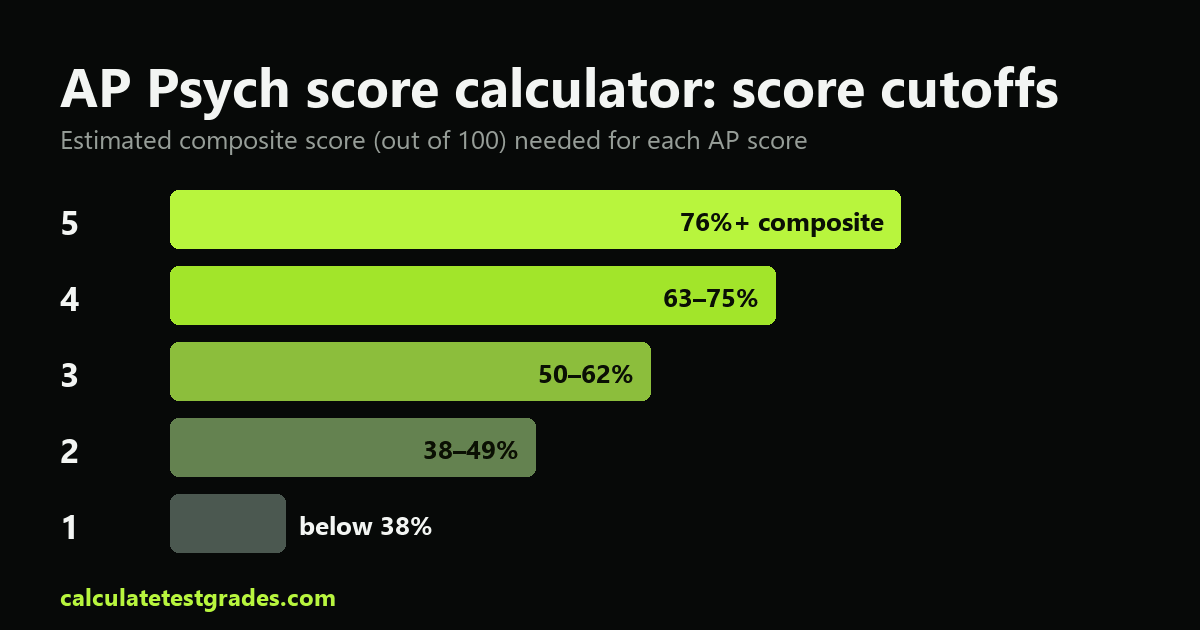
These cutoffs are estimates based on scoring data from past AP Psych exams. The College Board sets the exact cutoffs each year so that a 4 means the same level of achievement from one year to the next, which means the real numbers can move by a few points. Treat a composite within two or three points of a cutoff as a borderline result.
Worked example with the AP Psych score calculator
Suppose a student gets about 70% of the multiple-choice questions right and about 60% of the free-response points on a practice AP Psych exam:
- Multiple choice: 53 of 75 points → 53 ÷ 75 × 66.7% = 47.1
- Article analysis question: 4 of 7 points → 4 ÷ 7 × 16.7% = 9.5
- Evidence-based question: 4 of 7 points → 4 ÷ 7 × 16.7% = 9.5
Composite: 66.2 out of 100, which predicts a 4 on AP Psych. To move up to a 5, the student needs about 9.8 more composite points.
How to raise your AP Psych score
Multiple choice is two thirds of the AP Psych exam, so vocabulary and concept application matter most. Practise applying each term to a short scenario, because the questions test application rather than definitions.
The article analysis question rewards research methods knowledge: identify the method, variables, sample, ethics and whether the findings can be generalised. Learn these terms precisely.
For the evidence-based question, make a clear claim, cite the provided sources by number and explain how each piece of evidence supports your claim using psychology concepts.
After each practice test, enter your new points in the AP Psych score calculator and compare the result with your last attempt. Tracking your composite over several weeks shows whether your study plan is working and which section deserves your next hour of review.
What your AP Psych score means for college
AP scores run from 1 to 5. Many colleges give credit or placement for a 3 or higher, while selective colleges often ask for a 4 or 5 and some give credit only for a 5. Policies differ by college and by subject, so check the AP credit page of every school on your list. The College Board explains the full scale on its AP scores page.
AP classes can also raise your weighted GPA, because many high schools add a bonus point for AP courses. See how much with the high school GPA calculator, and use the final exam grade calculator to protect your class grade before the exam.
Other AP score calculators
- AP score calculator for all exams
- AP Lang score calculator
- AP Lit score calculator
- AP Bio score calculator
- AP Chem score calculator
- AP Calc AB score calculator
- AP Calc BC score calculator
- AP Stats score calculator
- AP World score calculator
- APUSH score calculator
- AP Euro score calculator
- AP Gov score calculator
- AP Physics 1 score calculator
- AP Physics 2 score calculator
- AP Physics C Mechanics score calculator
- AP Macro score calculator
- AP Micro score calculator
- AP Precalc score calculator
- AP CSA score calculator
- AP CSP score calculator
- AP Human Geography score calculator
- APES score calculator
Frequently asked questions
How is the AP Psychology exam scored?
The AP Psych exam has 3 scored parts: Multiple choice (66.7%); Article analysis question (16.7%); Evidence-based question (16.7%). Each part is converted to a weighted score, the parts are added into a composite score, and the composite is converted to an AP score from 1 to 5.
What composite score do you need for a 5 on AP Psych?
Based on past exams, a composite of about 76 out of 100 has been enough for a 5 on AP Psych, about 63 for a 4 and about 50 for a 3. The College Board adjusts the exact cutoffs every year, so treat these as estimates.
Is a 3 a good score on AP Psych?
Yes. A 3 means “qualified” and earns credit or placement at many colleges. Selective colleges often require a 4 or 5, so check the AP credit policy of each college you are interested in.
How accurate is this AP Psych score calculator?
The section weights follow the official AP Psych exam format, so the composite is accurate for the points you enter. The score cutoffs are estimates from past exams, so your real AP score can differ by one point when your composite is close to a cutoff.
Is there a penalty for wrong answers on the AP Psych exam?
No. AP exams do not take off points for wrong multiple-choice answers, so answer every question, even if you have to guess.